


Talent vs Practice Why Creativity Is Built Through Habit

Some people make creativity look effortless. They sit at a piano and find a melody. They open a notebook and fill the page. They hear a beat in their head and turn it into a song before dinner.
From the outside, it can look like magic. It can look like they were born with something rare and the rest of us were not.
That story is comforting when we are afraid to try. If creativity belongs only to the gifted, then we never have to sit through the awkward beginner phase. We never have to write the bad verse, sing the shaky note, draw the strange sketch, or make the beat that does not quite land.
But creativity is not reserved for a chosen few. Creativity grows through practice, repetition, attention, and play. Talent may give someone a head start, but habit is what carries them forward.
A writer writes. A dancer dances. A painter paints. A music maker makes music. Not only when inspiration appears, but because the act itself builds the skill.

Talent is real, but it is not the whole story
Talent exists. Some people pick up rhythm quickly. Some hear pitch with ease. Some naturally notice color, movement, words, or patterns. Natural ability can make the first steps feel smoother.
But talent is not the same as mastery.
A naturally gifted singer still has to learn breath control. A talented producer still has to learn arrangement, sound selection, and mixing. A funny writer still has to write enough weak lines to find the strong ones. A dancer with natural coordination still needs hours of movement before the body learns control.
Talent may open the door, but practice walks through it.
The problem comes when people treat talent as a fixed identity. They say:
“I’m just not creative.”
“I’m not musical.”
“I can’t draw.”
“I don’t have that kind of brain.”
“I missed my chance.”
Those statements often sound like facts, but they are usually stories built from limited experience. Maybe someone laughed at a drawing in middle school. Maybe a music teacher made theory feel impossible. Maybe the first song came out clumsy, so the person decided songwriting was not for them.
A rough beginning does not prove a lack of talent. It proves the skill is new.
Most creative ability comes from repeated contact with the craft. The more time spent making, noticing, correcting, and trying again, the more “natural” the skill starts to feel. Over time, practice can look like talent from the outside.
That is why the phrase talent is practice carries so much truth. What people call natural often comes from hours they never saw.
The myth of waiting for inspiration keeps people stuck
One of the biggest myths about creativity is that inspiration has to arrive before creation can begin.
This myth sounds romantic. The artist waits by the window. The right feeling appears. The song pours out. The painting reveals itself. The poem arrives fully formed.
Sometimes that happens. A strong idea can hit suddenly. A lyric can come while driving. A melody can appear in the shower. A scene can unfold in the mind at the most random time.
But if creativity depends only on those moments, the artist gives up control.
Habit creates more chances for inspiration to show up. When the body and mind know, “This is the time we make things,” ideas begin to meet the schedule. They may not arrive fully shaped, but they arrive often enough to work with.
A person who writes for 20 minutes every morning does not wait to become a writer. They build the identity through action.
A dancer who practices footwork after school does not wait to feel graceful. They train the body until grace becomes possible.
A painter who returns to the canvas every evening does not need every session to feel special. They learn color, pressure, texture, and patience through the act of painting.
A music maker who opens the laptop, keyboard, or instrument each day learns by making sound. Some days the beat works. Some days it does not. Both days count.
Inspiration is easier to find when it knows where to look for you.
This is especially true in music. Many beginners ask, “Can anyone make music?” The better question is, “What happens if I practice making music before I judge whether I am musical?”
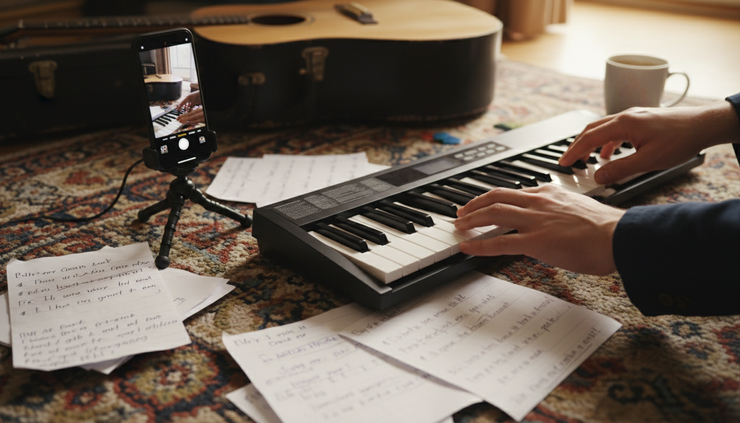
Think you're not musical? Discover why creativity is a skill that can be developed and how anyone can learn to write and produce original music. Can anyone make music? Learn music production. Songwriting for beginners. Creativity. Music education. Producer mindset. Beginner music lessons. Music Makers Academy.
That idea matters because music often feels mysterious from the outside. People hear finished songs and forget how many messy drafts, loops, voice memos, and experiments came before the final version.
Daily habits make creativity easier to access
Creativity needs space. It also needs structure. That may sound strange because creative work often feels open and free, but structure gives the mind a place to begin.
The best habits are simple enough to repeat. They do not need to be dramatic. They need to be real.
Clear the mind before creating
A cluttered mind makes creative work harder. When thoughts are racing, every idea has to compete with worries, reminders, messages, and unfinished tasks.
Mental clarity creates room for ideas, feelings, and visions to move.
Meditation can help. It does not have to be long or complicated. Sitting quietly for a few minutes, breathing slowly, and noticing thoughts without chasing them can create a reset. Some people pray. Some journal. Some take a quiet walk. Some sit with a cup of tea before touching an instrument.
The method matters less than the result. The goal is to create enough inner space to focus on the task at hand.
For music makers, that might mean taking five quiet minutes before opening a session. Instead of jumping straight into sounds while distracted, the mind gets a chance to settle. Then the first chord, drum pattern, lyric, or melody has more room to appear.
Move the body to wake up the mind
Exercise can support creativity because movement changes the state of the body. A quick walk, stretch, bike ride, dance session, or set of push-ups can shake loose the fog.
Many creative blocks are not deep artistic failures. Sometimes the body has simply been still too long. Movement gets blood flowing and helps shift attention.
A short walk can lead to a lyric. Dancing around the room can reveal what kind of beat feels good. Stretching can relax tension before singing. Movement reminds the body that creativity is physical too.
This does not mean every artist needs an intense fitness routine. It means the body and mind work together. If the mind feels stuck, move the body and see what changes.
Set aside time to make something
Time commitment turns creativity from a wish into a practice.
A person does not need eight free hours to build skill. A consistent 30 minutes can do more than one random marathon session every few months. The key is to protect the time.
That creative window should have a clear purpose. For example:
Write one verse.
Make one drum loop.
Practice one chord change.
Record three melody ideas.
Sketch one object from the room.
Dance to one song without stopping.
Revise one paragraph.
Small assignments remove pressure. They also give the brain a reason to start.
The goal is not always to finish something. Some days are for collecting pieces. A strange synth sound, one honest line, a new rhythm, or a rough chorus can become useful later.
Creative people often look productive because they have built a large pile of raw material. Habit helps build that pile.

Practice teaches what talent cannot
Practice does more than repeat the same action. Good practice teaches awareness.
At first, beginners often cannot tell what is wrong. A song feels flat, but they do not know why. A drawing looks off, but they cannot name the issue. A dance move feels awkward, but the correction is unclear.
With time, the senses sharpen.
A music producer starts to hear when the kick and bass fight each other. A songwriter notices when a line has too many syllables. A singer feels when the note needs more breath. A painter sees when the values lack contrast.
This kind of awareness rarely appears all at once. It grows through contact.
Practice also builds taste. The more someone creates, the more they learn what they like and what they are trying to express. They begin to recognize their own patterns. They find certain chords, colors, words, rhythms, or movements that feel honest.
At first, practice may feel mechanical. Later, it becomes personal.
That is when creativity starts to feel more natural. The hands know where to go. The ear catches details faster. The body trusts movement. The mind stops panicking at a blank page.
The person has not become magically different. They have become trained.
Freedom matters as much as discipline
Consistent practice builds skill, but freedom keeps creativity alive.
The fear of judgment can kill an idea before it has a chance to breathe. Many people stop themselves too early because they imagine what others will think.
“That sounds weird.”
“This is silly.”
“No one will like this.”
“This does not match what real artists do.”
Those thoughts may appear, but they do not deserve control. Creative work needs room for the strange, playful, and unpolished. Some of the best ideas begin as something awkward or funny.
Be willing to make the weird song. Write the dramatic lyric. Choose the odd color. Dance in a way that makes no sense yet. Make the beat that feels too simple. Record the voice memo even if the vocal is shaky.
Create for the enjoyment of it, not only for approval.
This does not mean feedback has no value. Feedback can help. Training can help. Taste can improve. But feedback works best after something exists. If fear prevents the first draft, there is nothing to shape.
The private creative space should feel safe enough for experiments. Nobody needs to hear every rough idea. Nobody needs to see every sketch. The early stage belongs to curiosity.
Freedom gives creativity oxygen. Discipline gives it roots.
A simple weekly practice plan for building creativity
Creative growth becomes much easier when the plan is clear. Here is a simple structure anyone can adapt, especially for music, writing, visual art, or movement.
Day | Creative focus | Simple goal |
Monday | Generate ideas | Make three rough ideas without judging them. |
Tuesday | Practice technique | Work on one small skill, like chords, rhythm, shading, or timing. |
Wednesday | Study work you love | Notice one detail and try a similar exercise. |
Thursday | Create freely | Make something strange, fun, or low-pressure. |
Friday | Refine one piece | Choose one idea and improve it for 30 minutes. |
Saturday | Share or record progress | Save, export, film, or show one small piece. |
Sunday | Rest and reflect | Write down what felt good and what to try next. |
This plan is not a rule. It is a starting point. The real value comes from returning again and again.
A beginner music maker might use Monday to make three melodies, Tuesday to practice chord progressions, Wednesday to study a favorite song structure, Thursday to create a strange beat, Friday to improve one loop, Saturday to record vocals, and Sunday to listen back.
Over time, this pattern builds confidence. It also proves something important. Creativity is not a personality trait reserved for rare people. It is a relationship with practice.

Keep showing up and let the skill grow
The truth about talent and practice is both humbling and hopeful.
Talent is real, but it does not remove the need for work. Practice is real, and it can carry someone much farther than they expected. Creativity grows when people make room for it, return to it, and stop demanding perfection before they begin.
Do not wait until the idea feels brilliant. Do not wait until the voice sounds perfect. Do not wait until the song, sketch, dance, or paragraph feels worthy of being seen.
Start with the habit.
Make the thing. Learn from it. Make another thing. Clear the mind, move the body, set the time, and give yourself permission to be unusual.
The more often you create, the less creativity feels like a mystery. It becomes something you can meet every day.


Comments