

How Learning Music Rewires the Brain and Turns Ideas into Sound
Learning music is one of the few activities that asks the brain to listen, move, remember, predict, feel, and correct mistakes at the same time. A beginner pressing a piano key, a drummer holding a groove, or a vocalist matching pitch is doing far more than “practicing music.” The brain is building new pathways.
This is the neuroscience of learning music in plain terms: music practice creates intense multi-sensory coordination. That coordination can trigger neuroplasticity, the brain’s ability to change its structure and function through repeated use. Over time, research suggests music training is linked with stronger connections between brain regions, more efficient communication between the two hemispheres, and changes in areas involved in hearing, movement, memory, attention, and emotion.
That is why music can feel so different from passive listening. It turns thought into action. It turns sound into movement. And at its best, it turns an idea that exists only in the mind into something real that another person can hear.
Music practice wakes up many parts of the brain at once
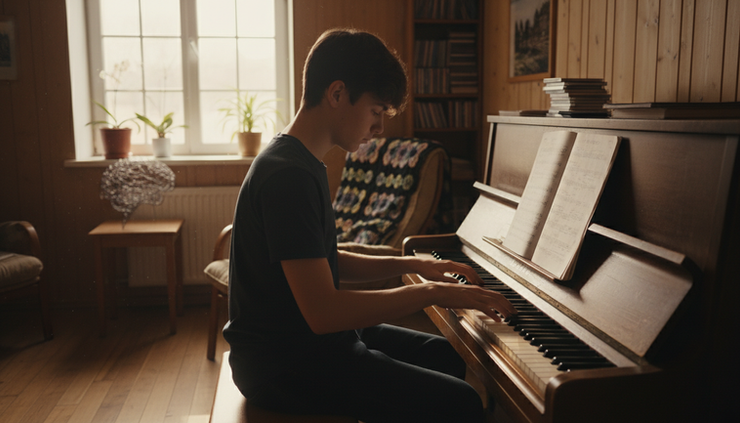
Playing music is a full-brain task. It is not limited to one “music center.” Even a simple melody can involve hearing, timing, fine motor control, decision-making, memory, emotion, and prediction.
Think about what happens when a student reads a few notes and plays them on an instrument:
The eyes track the score or chord chart.
The ears monitor pitch, tone, and timing.
The hands, voice, or breath produce the sound.
The brain compares the intended sound with what actually happened.
The body adjusts the next movement in a fraction of a second.
That loop repeats again and again. Each repetition gives the nervous system feedback. Was the note too early? Was the pitch sharp? Did the rhythm rush? Did the hand tense up? The brain keeps updating the plan.
This is why learning music often feels hard at first. The brain is not just memorizing facts. It is coordinating systems that usually work separately. With practice, those systems begin to communicate faster and more smoothly.
This article is informational only and does not replace medical or mental health advice. Still, the overlap between Mental Health and Music is meaningful. For many people, learning how to make music can support emotional expression, focus, stress relief, and a sense of progress, even when it is not a substitute for therapy.
The auditory cortex learns to hear with more detail
The auditory cortex sits in the temporal lobe and helps process the sound world. It plays a major role in hearing pitch, tone, timbre, rhythm, and subtle changes in sound.
For a new musician, two notes might sound almost the same. With training, the auditory system becomes more refined. A guitarist starts to hear whether a string is slightly out of tune. A singer notices the difference between a bright vowel and a warm one. A producer hears the shape of a snare drum, not just that “a drum happened.”
This is not only about having “a good ear.” Ear training is learned attention. The brain becomes better at separating details that were once blended together.
Music practice can sharpen the way the auditory cortex responds to:
Pitch
The highness or lowness of a sound.
Tone
The quality and color of the sound.
Timbre
The difference between the same note played on a violin, piano, voice, or guitar.
Timing
The space between sounds, including rhythm and groove.
This matters because hearing more clearly changes how a student plays. The better the brain can detect sound, the better it can guide the hands, voice, or breath.
The motor cortex and cerebellum build timing and control
Music is physical. Even when it feels emotional or intellectual, the body has to execute it.
The motor cortex helps plan and control voluntary movement. The cerebellum helps fine-tune timing, coordination, balance, and precision. Together, they support the thousands of tiny adjustments musicians make while playing.
A pianist learns how far to press a key. A drummer learns how hard to strike a cymbal. A violinist learns how much pressure to use with the bow. A vocalist learns how to coordinate breath, posture, and vocal fold control. These are not random movements. They become trained motor patterns.
That is what people often call muscle memory, though the memory is not stored in the muscles alone. It reflects changes in the nervous system. The brain and body learn a repeated pathway until the movement becomes easier to access.
At first, every action demands attention. A beginner guitarist may need to think about each finger in a chord. After enough practice, the hand can find the shape with less conscious effort. That frees the mind to listen, feel, and make musical choices.

The prefrontal cortex helps musicians plan and choose
The prefrontal cortex is involved in executive function. It helps with planning, focus, decision-making, problem-solving, and self-control. Music practice gives this system plenty to do.
A musician must make decisions constantly:
What comes next in the song?
Should the passage be louder or softer?
Is the rhythm steady?
Which fingering will make the next measure easier?
How should the phrase feel?
Reading music also calls on the prefrontal cortex. The brain has to decode symbols, predict what comes next, and prepare the movement before the note arrives. Improvisation uses it too, but in a different way. The musician chooses, reacts, and adjusts in real time.
This is one reason music education can build more than musical skill. Practice trains sustained attention. It also trains the ability to notice errors without stopping completely. That is a powerful skill.
Many learning environments teach correctness as a simple right-or-wrong result. Music teaches something more useful: hear the mistake, understand it, correct it, and keep going.
That loop builds patience. It also helps students become more comfortable with gradual improvement.
The hippocampus and amygdala connect music with memory and emotion
Music and memory are deeply connected. A song can bring back a place, a person, or a moment with surprising force. The hippocampus helps encode and retrieve memory. The amygdala helps process emotion, including emotional meaning and intensity.
When students learn music, they are not only storing notes. They are storing patterns, moods, lyrics, movements, and emotional associations. A melody may become linked with a certain feeling. A chord progression may carry tension and release. A rhythm may feel energetic, calm, playful, or serious.
This is why music can become such a strong form of self-expression. It gives shape to things that may be hard to explain in normal speech.
A student who writes a song is doing several things at once:
remembering sounds they have heard before
choosing patterns that match a feeling
organizing musical ideas into a form
turning an inner experience into an outer one
That last step is the bridge between neuroscience and creativity. The brain takes an invisible idea and gives it sound, rhythm, and structure.
Practice can strengthen the brain’s communication pathways
One of the most fascinating findings in music neuroscience involves the corpus callosum. This thick band of white matter connects the left and right hemispheres of the brain. It helps the two sides share information quickly.
Music often demands strong communication between hemispheres. A pianist may play different rhythms in each hand. A drummer may coordinate all four limbs. A singer may read lyrics, track pitch, and shape emotion at the same time. These tasks require fast back-and-forth communication.
Research suggests that long-term music training is associated with differences in the corpus callosum, including greater development in certain areas, especially when training begins early. This does not mean music is magic or that every student’s brain changes in the same way. It means repeated musical training can be a strong driver of structural growth.
White matter matters because it affects communication speed and efficiency. Stronger pathways can help information move more smoothly between regions. In simple terms, the brain gets better at sending messages where they need to go.
Gray matter can also change with music training. Studies have linked musical practice with gray matter differences in regions involved in hearing, movement, and memory. Gray matter contains many of the brain’s cell bodies and processing centers. When a skill is practiced often, the regions involved in that skill may adapt.

Music builds focus through repetition and correction
Good practice is not just repetition. It is repetition with attention.
A student plays a passage, listens, notices what changed, and tries again. That creates an error-correction loop. The brain compares the goal with the result. Then it updates the next attempt.
This kind of practice trains focus in a practical way. It teaches the student to stay with one problem long enough to improve it. It also teaches flexible attention. Sometimes the focus is rhythm. Sometimes it is tone. Sometimes it is posture, breath, fingering, or expression.
Over time, this can make practice feel less like forcing and more like noticing.
A useful practice loop looks like this:
Choose one small target
Work on a scale, phrase, rhythm, chord change, or vocal line.
Play slowly enough to notice
Speed can hide problems. Slower practice makes the brain’s feedback clearer.
Listen for one detail
Focus on timing, pitch, tone, or relaxation.
Correct one thing
Avoid trying to fix everything at once.
Repeat with intention
The brain learns from focused repetition, not from mindless running through.
This is how musical skill becomes more stable. The nervous system learns what to expect and how to respond.
Learning music can support cognitive reserve
Cognitive reserve refers to the brain’s ability to stay flexible and function well despite aging or stress on the system. It is shaped by many factors, including education, social connection, physical health, sleep, and mentally engaging activities.
Music is one of those mentally engaging activities. It combines memory, attention, listening, movement, emotion, and problem-solving. That rich combination may help support long-term brain health.
No single activity can guarantee protection from cognitive decline. Still, research suggests that lifelong learning and complex skill practice can contribute to a more resilient brain. Music fits that pattern well because it keeps asking the brain to adapt.
Even better, music can grow with the learner. A student can start with simple rhythms and build toward songwriting, performing, producing, improvising, or arranging. There is always another layer to explore.
That matters for motivation. The brain benefits from challenge, but people stick with challenge when it feels meaningful. Music offers both.
Making music turns imagination into something real
The most powerful part of learning music may be what happens after the brain starts to coordinate all these systems. Students begin to create.
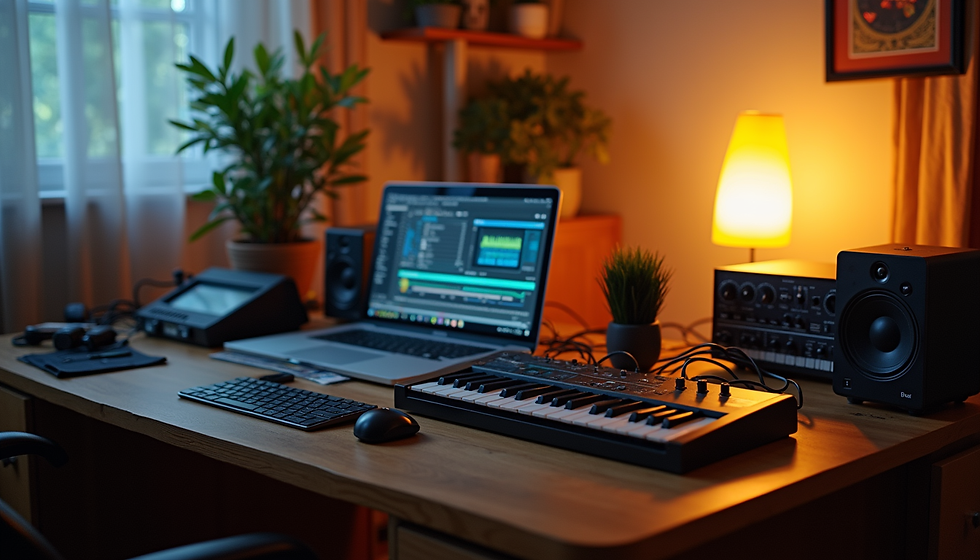
An idea can start as a hum, a beat tapped on a table, a lyric written in a notebook, or a feeling that has no words yet. Through musical training, that idea can become a recording, a performance, a song, or a shared moment.
This is where Music Makers Academy plays an important role. Students are not only learning notes, rhythms, and technique. They are learning how to take an idea that exists only in the mind and make it tangible. That process builds confidence because the student can point to something real and say, “I made this.”
That kind of creation changes the way learning feels. Music is not only an exercise for the brain. It becomes proof that effort can become expression.
A young songwriter may begin with three chords and a chorus. A producer may start with a drum pattern and build a track around it. A singer may shape a melody until it finally matches the feeling behind the words. Each project teaches the brain a new pattern of listening, choosing, adjusting, and finishing.

The real reward is a brain that keeps learning
Learning music rewires the brain because it asks for coordinated effort. The auditory cortex learns to hear more detail. The motor cortex and cerebellum refine movement and timing. The prefrontal cortex plans, focuses, and corrects. The hippocampus and amygdala connect sounds with memory and emotion. White matter pathways, including the corpus callosum, can become more efficient through repeated practice.
The result is more than better technique. Music training can build attention, persistence, emotional expression, and creative confidence.
A student begins with uncertainty. A note feels awkward. A rhythm falls apart. A melody exists only as a vague idea. Then practice gives the brain a map. The hands, ears, memory, and imagination learn to work together.
That is the quiet power of music education: it helps the brain change, and it helps a person turn inner life into sound.


Comments